






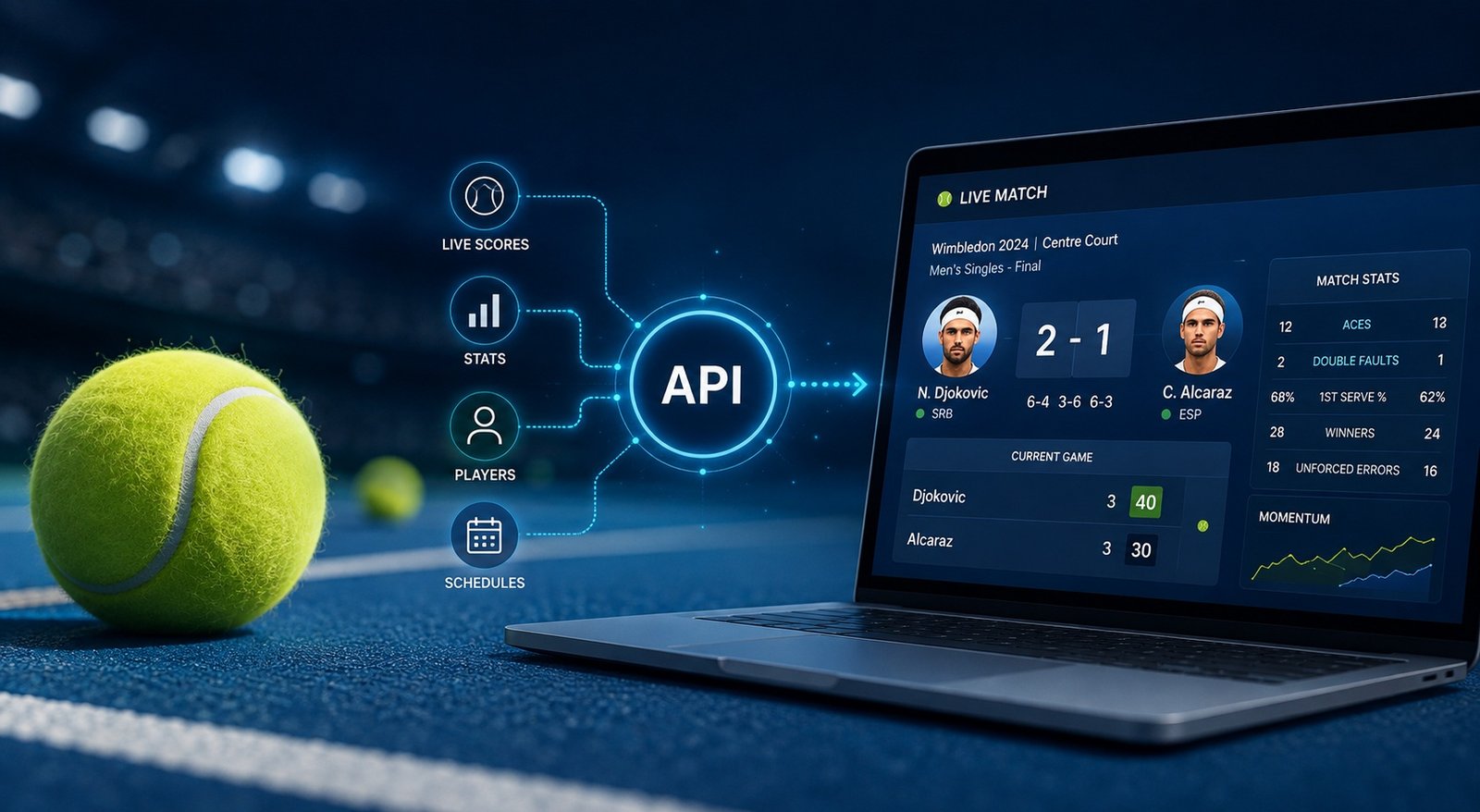
Sports applications have changed dramatically in recent years. Fans no longer want to wait until a tennis match ends to see the result. They expect live scores, match statistics, player information, and important updates while the action is happening.
For developers, providing this experience creates an important challenge: where does all that live tennis data come from?
Collecting scores and match information manually is not practical for a modern application. A developer may need to track many tournaments and matches at the same time. The information also needs to be structured correctly so that websites, mobile apps, dashboards, and other platforms can process it quickly.
This is where tennis API integration becomes useful.
A tennis data API provides a connection between a sports data source and an application. Developers can request information such as live scores, matches, player statistics, point-by-point data, and other tennis information and then display it inside their own products.
This guide explains how tennis APIs work, what developers can build with real-time sports data, and what to consider before integrating one into an application.
What Is a Tennis API?
A tennis API, or Application Programming Interface, allows one software application to request tennis information from another service.
Think of an API as a bridge.
Instead of collecting tennis data yourself, your application sends a request to a data provider. The provider receives the request and returns the requested information in a structured format.
The basic process looks like this:
Tennis data provider → API → Developer’s application → End user
For example, imagine that you are developing a mobile application showing tennis matches currently in progress.
Your application requests the latest match information from the API. The API may return information such as:
- Player names
- Match status
- Tournament
- Current score
- Set scores
- Serving player
- Match statistics
- Match time
Your application can then turn that raw information into an attractive live scoreboard.
Why Developers Use Tennis APIs
Building a sports application from scratch involves more than designing a website or mobile interface.
The application also needs data.
Trying to collect information independently from many tournaments would require considerable infrastructure. Developers would have to gather the information, organize it, keep it updated, and make sure their applications could access it reliably.
Using a tennis api allows developers to access structured tennis information without having to build the entire underlying data collection system themselves.
This means development teams can spend more time creating features that users actually interact with.
Instead of asking:
“How do we collect tennis scores?”
Developers can focus on:
“How can we create the best experience with this tennis data?”
That difference can save significant development time.
What Type of Data Can a Tennis API Provide?
The exact information available depends on the API provider and plan.
Some APIs focus mainly on scores, while others offer more detailed information for analytics and advanced sports applications.
Here are common examples:
| Tennis Data | How Developers Can Use It |
|---|---|
| Live scores | Real-time scoreboards |
| Match schedules | Upcoming match pages |
| Results | Completed match archives |
| Player data | Player profiles |
| Rankings | ATP/WTA ranking pages |
| Match statistics | Performance dashboards |
| Point-by-point data | Detailed match tracking |
| Tournament data | Tournament pages |
| Historical matches | Research and analytics |
| Odds or market data | Betting-related analytics |
A simple tennis news website might only need schedules, live scores, and results.
A more advanced analytics application could require point-by-point information, historical results, rankings, statistics, and market data.
Understanding the application’s purpose before selecting an API is therefore important.
How Tennis API Integration Works
API integration may sound complicated to beginners, but the basic idea is straightforward.
The developer first receives access credentials from the API provider. Depending on the service, this could involve an API key or another authentication method.
The application then sends a request to a specific endpoint.
An endpoint represents a particular type of information.
For example, an API might conceptually provide endpoints for:
/live-matches
/matches
/players
/rankings
/statistics
If an application needs live matches, it sends a request to the appropriate endpoint.
The API then returns structured data.
Many modern APIs return information using JSON.
A simplified example could look like this:
{
  "match_id": 10520,
  "status": "live",
  "player_1": "Player A",
  "player_2": "Player B",
  "sets": "1-1",
  "current_game": "40-30"
}
The application reads these values and decides how to display them.
Users never need to see the JSON. They might simply see:
Player A vs. Player B
Sets: 1–1
Current Game: 40–30
This is the basic principle behind many API-powered sports products.
Building a Real-Time Tennis Score Application
Live score applications are one of the most common uses of tennis APIs.
Imagine building a website that shows all tennis matches currently being played.
The application could follow this process:
- Request currently active matches.
- Receive the latest tennis data.
- Process the JSON response.
- Display matches on the website.
- Update the information as matches progress.
The user might see a dashboard containing several matches.
| Match | Status | Sets | Current Score |
|---|---|---|---|
| Player A vs. Player B | Live | 1–1 | 40–30 |
| Player C vs. Player D | Live | 0–1 | 15–30 |
| Player E vs. Player F | Completed | 2–0 | Final |
In a real application, these values would come from the data provider rather than being manually entered.
The frontend could automatically refresh the information so users receive updated scores without repeatedly reloading the entire page.
REST APIs and Real-Time Updates
Many sports APIs use REST endpoints.
With a REST API, the application sends a request whenever it needs information.
The process looks like this:
Application sends request → API processes request → JSON data is returned
For schedules and completed results, occasional requests may be enough.
Live scores are different because the information changes frequently.
One common solution is polling.
With polling, the application requests updated information at regular intervals.
For example:
Request → Wait → Request again → Wait → Request again
This approach can work well for many applications.
However, developers should choose sensible intervals. Requesting data unnecessarily can increase server load and may cause the application to reach API rate limits.
More demanding applications may use streaming technologies such as WebSockets when supported by the data provider.
REST vs. WebSocket for Tennis Data
Both REST APIs and WebSockets can be useful, but they solve slightly different problems.
| Feature | REST API | WebSocket |
|---|---|---|
| Connection | Request-based | Persistent |
| Implementation | Usually simpler | More advanced |
| Live updates | Requires repeated requests | Can receive pushed updates |
| Schedules | Excellent | Usually unnecessary |
| Historical data | Excellent | Usually unnecessary |
| Highly responsive scores | Good with polling | Well suited |
| Server communication | Client requests data | Server can push data |
Developers do not always need WebSockets.
A simple application can work perfectly well using REST requests and appropriate caching.
The best option depends on how quickly the information must update and how many users the application needs to support.
Using Tennis APIs for Player Statistics
Live scores are only one possible feature.
Sports fans increasingly want context around a match.
They may want to know how a player has performed recently, current rankings, previous match results, or statistics from the match they are watching.
Developers can use structured data to build player dashboards containing information such as:
- Player profile
- Current ranking
- Recent results
- Match history
- Serve statistics
- Break points
- Winners
- Aces
- Other available performance metrics
This can transform a basic scoreboard into a much richer sports platform.
For example, instead of simply displaying a match score, the application could place live statistics beside it.
Users can then understand not only who is winning but also how the match is developing.
Point-by-Point Data for Advanced Applications
Point-by-point tennis data provides even greater detail.
Instead of only receiving the current set or game score, an application may be able to track individual points as the match progresses.
This type of data can be valuable for:
- Detailed live match centers
- Momentum charts
- Match timelines
- Tennis analytics
- Break-point tracking
- Performance models
- Research tools
A sports analytics platform could use point-level information to show how momentum changed during different stages of a match.
Developers should check exactly which competitions and matches include point-by-point coverage because availability can vary between data providers and plans.
Tennis APIs for Sports and Betting Applications
Real-time tennis data can also support betting-related technology and sports-market analysis where legally permitted.
These applications often need information quickly because the state of a tennis match can change after every point.
A platform might combine:
Live score + Match statistics + Point data + Market information
This information could then be used for market-monitoring dashboards, quantitative models, or other analytical tools.
However, developers building betting-related applications have additional responsibilities.
They should consider local gambling laws, licensing requirements, data rights, API terms, and responsible-gambling requirements.
Access to sports data does not automatically provide permission to operate a betting service.
Using Tennis Data for Notifications
Another useful feature is automated alerts.
Not every fan wants to keep a live-score page open for several hours.
Instead, users might choose a favorite player or match and receive notifications when something important happens.
Possible notifications include:
- Match started
- Set completed
- Match completed
- Score changed
- Selected player is playing
- Important match event occurred
The backend application can monitor relevant data and trigger notifications when predefined conditions are met.
These alerts could be delivered through a mobile push notification, email, messaging service, or directly inside the application.
Why JSON Is Useful for Sports Applications
JSON is widely used by web APIs because it is relatively lightweight and easy for software to process.
It also works with almost every major programming environment.
Developers using JavaScript, Python, PHP, Java, TypeScript, Go, and many other languages can work with JSON data.
This makes it possible for the same tennis API to support multiple types of products.
For example:
One data source → Website + Mobile app + Analytics dashboard + Internal tools
A company does not necessarily need a completely separate data source for every application it develops.
Important Features to Check Before Choosing an API
Developers should compare tennis data providers carefully.
Price is important, but it should not be the only consideration.
Data Coverage
Check which competitions are covered.
Depending on the project, developers may need data from ATP, WTA, Challenger, ITF, or other competitions.
Live Data
If the product depends on live scores, determine how frequently the data updates.
Historical Information
Analytics platforms may require previous match results rather than only current matches.
Point-by-Point Coverage
Check whether detailed point data is available for the tournaments relevant to your application.
Documentation
Clear documentation can make integration much easier.
Good documentation should explain authentication, endpoints, request parameters, response formats, errors, and rate limits.
Scalability
Think beyond the first version of the application.
A project with 100 users has very different infrastructure requirements from one serving 100,000 users.
Choosing a service that can grow with the product can reduce the need for a difficult migration later.
Build a Backend Between the API and Users
For larger applications, it is usually better not to have every user device repeatedly request the external API directly.
Instead, developers can use their own backend.
A common architecture looks like:
Tennis API → Application Backend → Cache/Database → Website or Mobile App
The backend requests external data and then distributes the necessary information to users.
This approach offers several benefits.
API credentials can remain protected on the server. Frequently requested information can be cached, and the application can control how data is processed before it reaches users.
Caching can also reduce unnecessary API requests.
For example, tournament information that rarely changes does not need to be downloaded every few seconds.
Live scores, on the other hand, may need much more frequent updates.
Common Tennis API Integration Mistakes
Even a good API can perform poorly if it is integrated incorrectly.
Common mistakes include requesting the same information too frequently, exposing API credentials in frontend code, ignoring rate limits, failing to cache suitable data, and assuming every tournament has identical data coverage.
Developers should also plan for errors.
An external service may occasionally be unavailable, a request might time out, or a particular field may be missing.
Applications should handle these situations gracefully rather than crashing or showing confusing information to users.
Final Thoughts
Real-time sports applications depend on fast, structured, and reliable information.
For tennis developers, APIs provide a practical way to access live scores, match information, player data, statistics, historical results, point-by-point updates, and other useful sports data without creating an entire data collection infrastructure from scratch.
The key is to start with the application’s actual requirements.
A simple score website may only need schedules, live scores, and results. A sophisticated sports platform may require rankings, historical matches, detailed statistics, point-level information, alerts, and market data.
Developers should compare data coverage, documentation, update methods, rate limits, scalability, and pricing before choosing a provider.
With the right API integration and a well-designed backend, raw tennis data can be transformed into live scoreboards, mobile applications, analytics dashboards, notifications, and other engaging sports experiences.
Ultimately, the API supplies the data, but thoughtful development turns that data into a useful product for tennis fans.