







Short answer: To write a design brief, describe your business and goal, the audience, the exact deliverables and formats, key messages and content, brand guidelines, examples you like and dislike, budget, deadline and who approves the work. A one to two page brief that answers these points gives a designer everything needed to get it right the first time and cuts revisions.
Key takeaways
- A clear brief is the single biggest factor in on-time, on-budget design projects.
- Define the goal and audience before describing visuals.
- List every deliverable with sizes, formats and where it will be used.
- Share examples you like and dislike, and explain why.
- Name one decision-maker to keep feedback focused.
What is a design brief?
A design brief is a short document that explains what you need designed, why, for whom and by when. It aligns you and your designer before any work begins, and becomes the reference point for feedback and approvals.
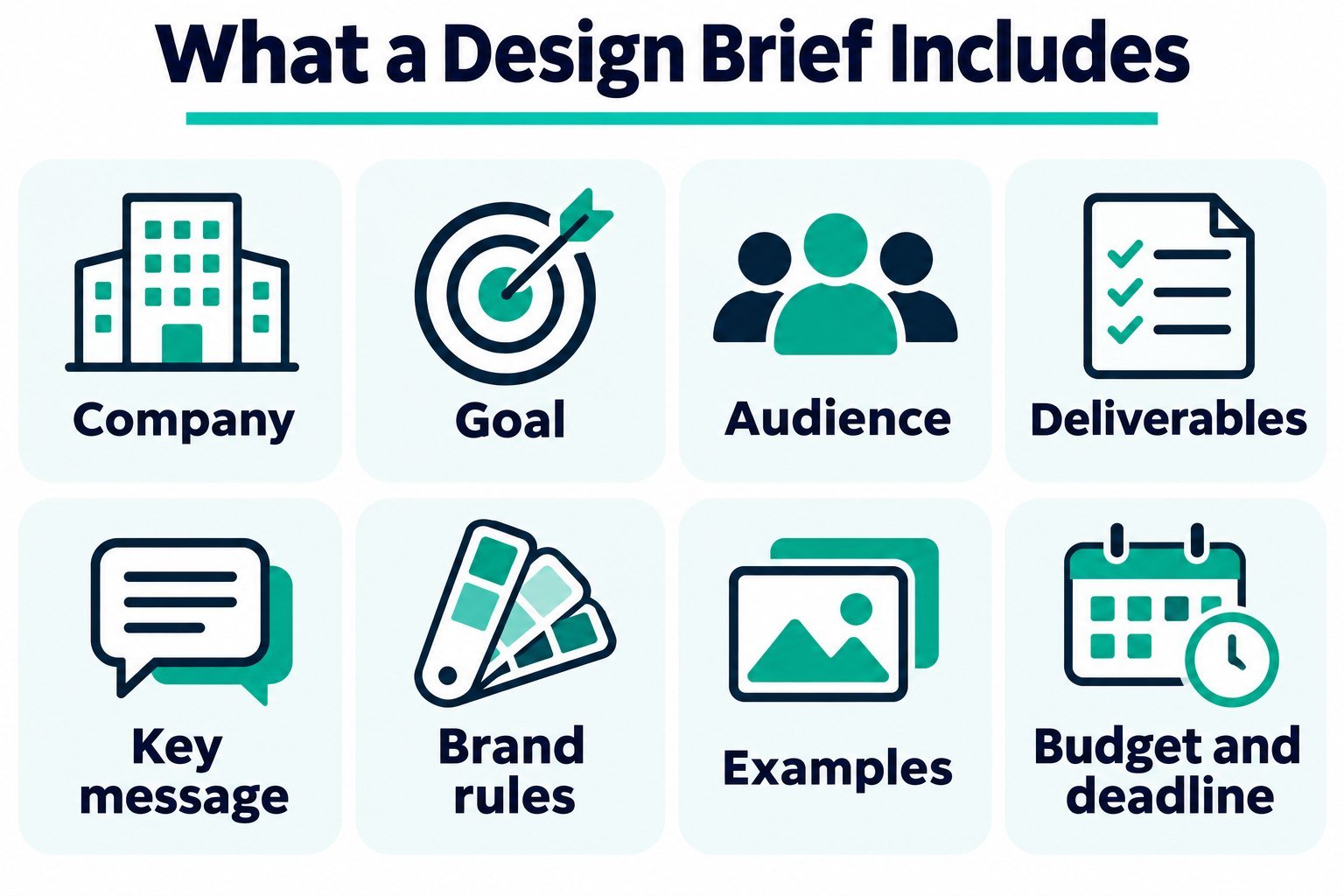
The 10 sections every design brief needs
- Company overview: what you do, your services and what makes you different.
- Project goal: the business result, such as more enquiries, a product launch or winning investors.
- Target audience: who they are, what they care about and where they will see the design.
- Deliverables: each item, size, format, quantity and channel (web, social, print).
- Key message and content: headline, body text, calls to action and any data or images to include.
- Brand guidelines: logo files, colors, fonts and tone of voice.
- Inspiration: 3–5 examples you like and dislike, with a sentence on why.
- Constraints: legal text, accessibility needs, print specifications or platform limits.
- Budget and timeline: including dates for drafts, feedback and final delivery.
- Approvals: who gives feedback and who has the final say.
Copy-and-paste design brief template
Project name:
Company and services:
Goal of this project:
Audience:
Deliverables (item, size, format, use):
Key message and call to action:
Content supplied by us:
Brand assets attached:
Examples we like / dislike and why:
Must include / must avoid:
Budget:
Deadlines (draft, feedback, final):
Decision-maker:
Common design brief mistakes
- Describing colors and fonts but not the business goal.
- Leaving content “to be decided”, which delays layouts.
- Forgetting formats, such as print sizes or social dimensions.
- Too many decision-makers giving conflicting feedback.
- Using vague words like “modern” or “pop” without examples.
Briefs for specific projects
- Logos and branding: include your values, competitors and where the logo must work. See graphic design services.
- Brochures, catalogs and company profiles: include page count, product data and print method. See brochure and catalog design.
- Pitch decks: include your story, numbers and audience (investors, buyers). See pitch deck design.
- Websites: include pages, features and SEO goals. See web design services.
Writing a brief when AI tools are involved
A good brief also makes AI-assisted design better. The same details you give a designer, such as audience, message, style references and exact text, produce more accurate AI drafts. Always ask your designer to check AI output for spelling, accuracy and brand fit. Learn more in AI vs graphic designer.
After the brief: keep the project on track
Agree on revision rounds, give consolidated feedback and refer back to the brief when making decisions. Our guide on how to give feedback on design explains how.
Ready to start? Send us your brief, or a rough outline, and we will help you complete it.
Design brief example: a company profile for a manufacturer
Seeing a completed brief makes the template easier to use. Here is a short, realistic example for a printed and digital company profile.
Project: 12-page company profile, print and PDF.
Company: family-owned metal fabrication business serving construction and agriculture clients in the US Midwest.
Goal: help sales reps win larger contracts by presenting capabilities, certifications and past projects professionally.
Audience: procurement managers and engineers who compare several suppliers.
Deliverables: A4/Letter print-ready PDF, a lighter PDF for email, and an editable template for future updates.
Key message: reliable, certified, on-time fabrication at scale.
Content supplied: company history, equipment list, certifications, five project summaries with photos, contact details.
Brand assets: logo files, brand colors, fonts.
Examples liked: clean industrial layouts with large photos; disliked: cluttered pages with many fonts.
Timeline: first draft in two weeks, final files in four weeks.
Decision-maker: operations director.
With this brief, a designer can plan page count, layout, photography needs and print specifications before drawing anything. Explore how we approach these projects on our brochure, catalog and company profile design page.
How to describe the look you want without design jargon
Many business owners struggle to describe visual style. You do not need technical vocabulary; you need clear comparisons and reasons.
- Use adjectives in pairs: “professional but friendly”, “premium but approachable”, “bold but not loud”.
- Share examples with reasons: “I like this site because the pricing is easy to find” is more useful than “I like this site”.
- Say what to avoid: colors, styles or imagery that would not suit your audience or that competitors already use.
- Think about the customer: describe how you want them to feel and what they should remember after seeing the design.
Brief checklist by project type
| Project | Extra details to include |
|---|---|
| Logo | Business values, competitors, where the logo appears, any symbols to avoid |
| Website | Page list, features, SEO keywords, integrations, content ownership |
| Pitch deck | Audience, story outline, data and charts, presentation format |
| Social media templates | Platforms, sizes, post types, who will edit them |
| Packaging or print | Dimensions, printer specifications, legal text, quantities |
How a good brief saves time and money
Unclear briefs cause the most common project problems: extra revision rounds, missed deadlines and designs that look good but do not achieve the goal. A complete brief reduces guesswork, so the first concepts are closer to what you need. It also gives you an objective reference when feedback becomes subjective, because you can ask whether a design meets the goal and audience described in the brief rather than whether someone personally likes a color. Clear feedback builds on that foundation; see how to give feedback on design.
Updating your brief during the project
Briefs can change, but changes should be deliberate. If your goal, audience or deliverables shift after work begins, update the brief, share it with your designer and agree on any impact on timeline or price. Small clarifications are normal; major changes are effectively a new project. Keeping the brief current also makes it a valuable record for future projects, so you are not starting from scratch next time.
Using your brief to compare designers
Sending the same brief to several designers lets you compare quotes fairly, because everyone is pricing the same scope. Pay attention to the questions each designer asks in response; thoughtful questions often reveal the strongest partner. Use our list of questions to ask a graphic designer alongside your brief, and consider whether a freelancer or agency fits the project best.
Briefs for websites and SEO projects
Website briefs need a few additional details: the main actions you want visitors to take, the services that matter most commercially, the keywords or questions customers use, and any existing pages that already rank in Google. Including this information helps the designer plan structure and content together, which is essential for both search visibility and conversions. Our small business website checklist is a useful companion, and our web design team can help you complete the brief.
Who should be involved in writing the brief?
Keep the group small. The person who owns the business goal should write or approve the brief, with input from whoever knows the customer best, such as sales or customer service. Include anyone who must approve the final design from the start, so their expectations are captured early rather than surfacing as late feedback. For larger projects, a short kickoff discussion with your designer to walk through the brief helps uncover gaps and questions before work begins, and it often saves an entire revision round.
Keep a copy of every brief you write. After a few projects you will have a library of examples that makes each new brief faster, and patterns will emerge about what information your designers always need from you.
Summary
A good design brief explains your business, goal, audience, deliverables, key message, brand rules, examples, constraints, budget, timeline and decision-maker on one or two pages. It saves time and money, keeps feedback objective and makes quotes comparable. Keep each brief as a reusable template for future projects.
Frequently asked questions
How long should a design brief be?
One to two pages is enough for most projects. Focus on goals, audience, deliverables, content, brand rules, examples, budget and deadlines.
Who should write the design brief?
The client usually writes it, often with help from the designer. The person who approves the final design should review it.
What is the difference between a creative brief and a design brief?
A creative brief usually covers campaign strategy and messaging; a design brief focuses on the specific visual deliverables, formats and requirements.
Can I give a designer a brief by message instead of a document?
Yes, as long as it covers the key sections. A written brief, in any format, prevents misunderstandings.
References
- Google Search Central: Creating helpful, reliable, people-first content: how Google evaluates content quality.
